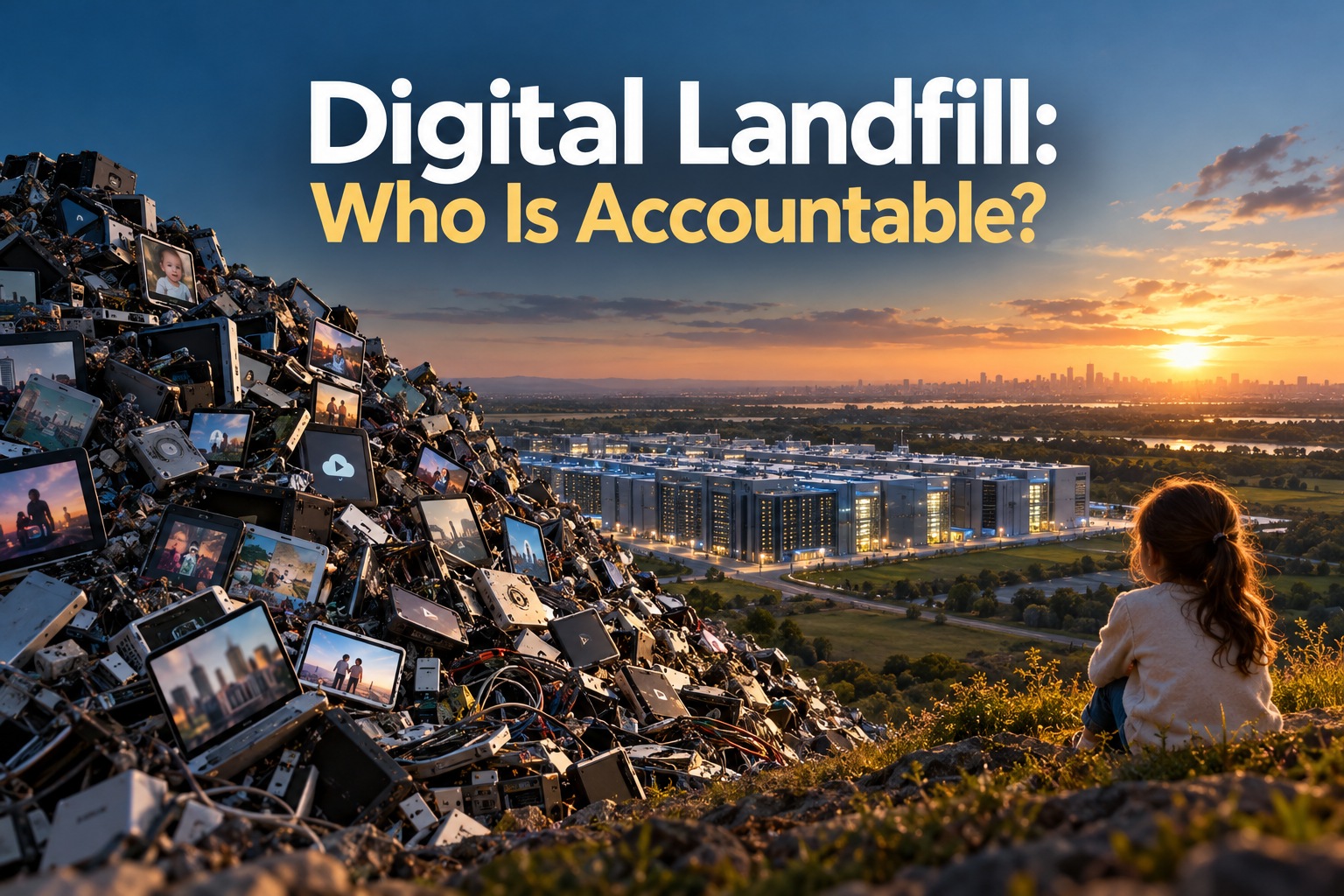
Who decides how long our digital data is kept, and who answers for its environmental cost?
As I was browsing my phone one morning, I thought: Where is this video I am watching stored?
Google has been part of our daily lives for over 25 years. Facebook for 20+. YouTube has been around for over 20 years. These are all relatively new technologies. Few of us anticipated how hooked we would become on our phones, or that everybody would start having their own digital media channels. We are all now visually creating our own movies.
Before, movies were sitting on tapes, and the photos that were generated were perishable. Photographs were printed, stored in albums and boxes, sometimes lost or thrown away. There were physical limits to how much we could keep.
Now the media that's getting generated is getting saved on plastic and metal, on hard drives, in data centers that are using up physical space. And this digital data can potentially live indefinitely.
The digital data we generate does not necessarily remain stored forever. Some is temporary, some is cached and eventually overwritten, and some is preserved for years. But all of this activity requires physical infrastructure and consumes resources.
So the question is, who is accountable for managing the enormous volumes of information being retained by technology companies? In some ways, we are all responsible for the data we generate and what we choose to keep.
But I strongly feel the companies making these decisions should be accountable for their data-retention practices and the resources they consume. Governments and policymakers should also be accountable for establishing and enforcing appropriate regulations. We as a society need to do our part too, whether by working with companies to purge unwanted data or by creating more awareness around this.
As individuals, we can delete unnecessary files and make more conscious decisions about what we preserve, especially if we use cloud storage heavily. But we cannot measure or regulate the vast amount of information these companies retain on our behalf.
In this age of social media, what we don't know right now is how much information technology companies retain, for what purpose, and for how long.
How much data are we actually keeping?
To put the scale of digital growth into perspective, in 2010, IDC estimated that approximately 1.2 zettabytes of digital information would be created or replicated worldwide that year.
In 2026, IDC's latest forecast projects approximately 274 zettabytes of annual digital data activity. 1 ZB = 1 trillion GB, or the capacity of 1 billion 1-TB hard drives. That is more than 200 times the volume estimated just 16 years ago. This includes information created, captured, replicated and consumed.
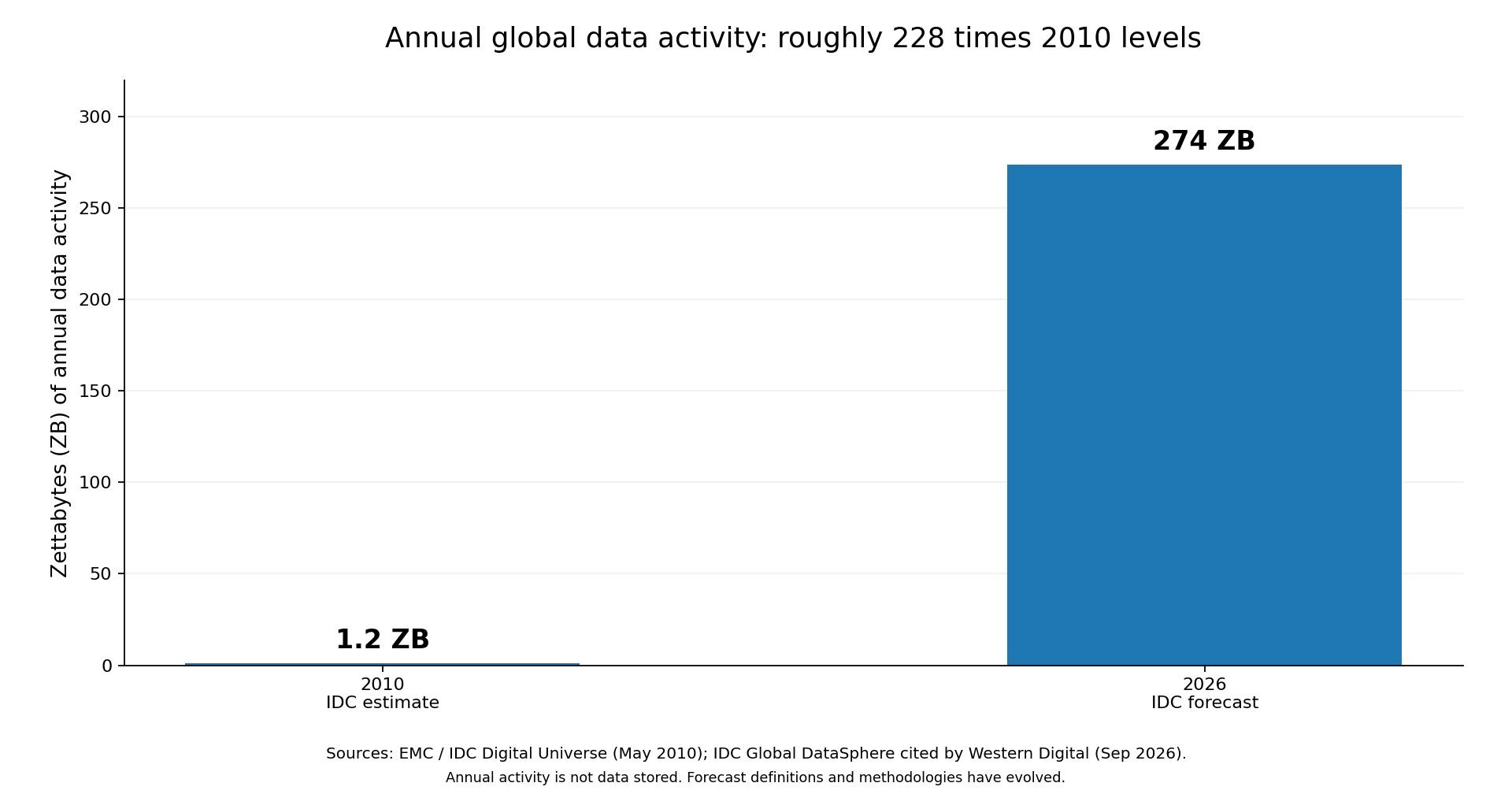
But data generation is not the same as data retention.
The question I am interested in is how much physical storage infrastructure we are building to retain the information we keep.
In 2012, IDC estimated worldwide installed raw storage capacity at approximately 2.6 zettabytes. By 2020, a newer estimate put installed capacity at approximately 6.8 zettabytes.
Today, in 2026, installed storage capacity worldwide is estimated at approximately 13 zettabytes, with projections indicating that it will more than double to over 26 zettabytes by 2030. That includes storage in data centers, businesses and personal devices.
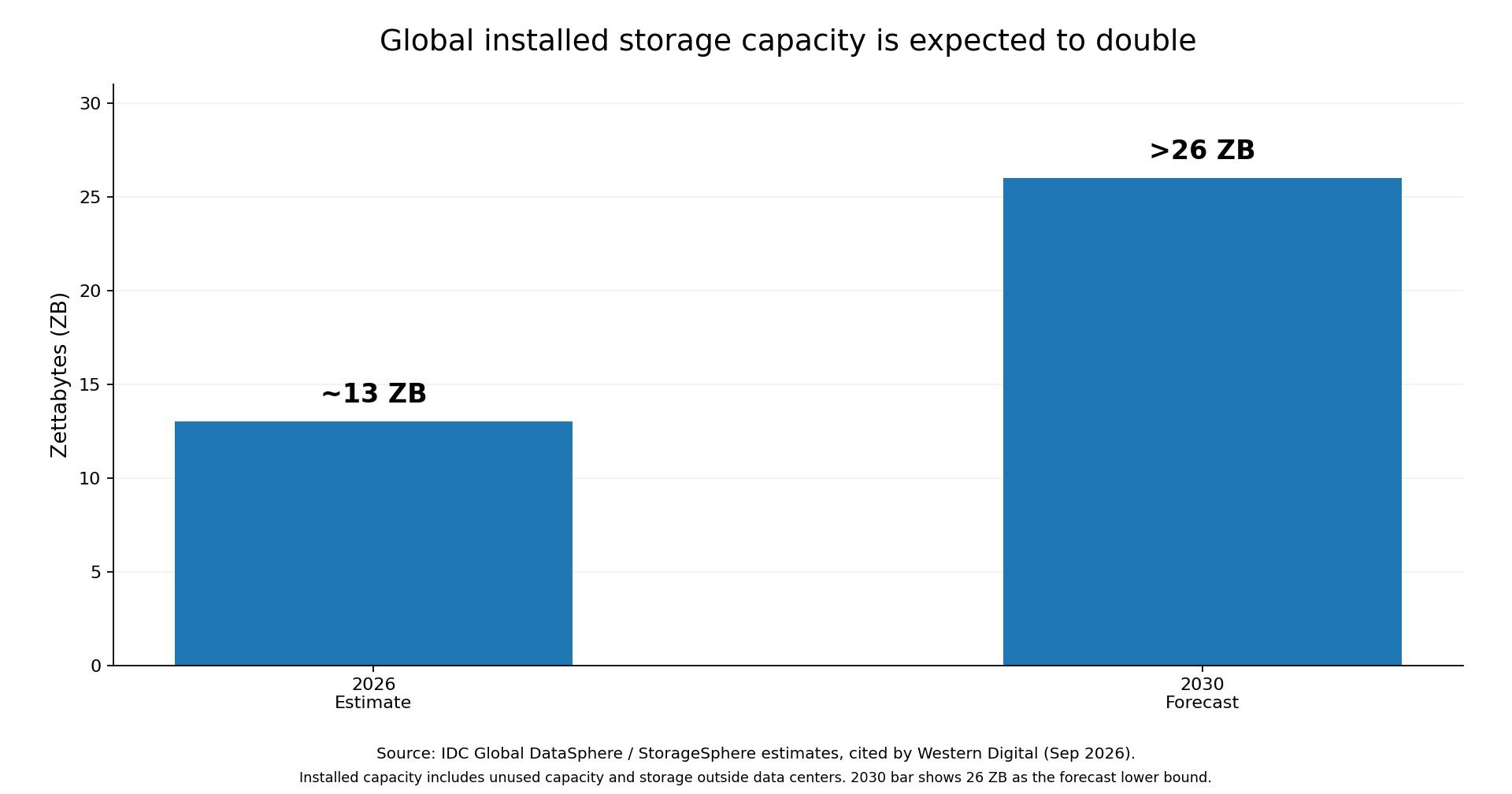
These figures represent installed capacity, including unused space. They do not tell us exactly how much data is being retained or how much of that information is necessary.
What is even more interesting is what is happening with AI.
A September 2026 IDC study, commissioned by Western Digital, surveyed 763 technology and business decision-makers across seven countries. Of those surveyed, 74.3% reported retaining data for longer periods because of AI adoption. Another 75.9% reported bringing previously archived information back into active use for AI workloads.
We are finding more reasons to preserve historical data, even data we may not have needed for years.
That makes me wonder how much of the information we are keeping is actually necessary, and how much we are preserving because it may someday become useful.
YouTube alone reports more than 20 million videos uploaded every day. That is just one platform.
When I upload a photograph or post something on social media, I created that content. But what about everything that gets generated around it? My activity, my preferences, the information that gets indexed, analyzed and used to draw conclusions about me?
We have privacy policies, and we have rights to request the deletion of certain personal information. Google, for example, publishes retention policies explaining that some information is deleted automatically, some remains until the user deletes it, and some is retained longer for legal or business purposes. Meta also publishes policies explaining the considerations it uses to determine retention periods.
So companies do have retention practices. But how do those practices translate into the total amount of physical storage they maintain?
I think, in a way, we have handed much of this responsibility over to the technology companies. We create the data, and they decide much of what happens to it.
This is no longer abstract
In Haskell County, Texas, farmer Cheyenne Buerger lost access to 600 acres he rented when his landlord sold the land for a Google data-center development. In another part of Texas, near Hereford, the first phase of a separate Google project is planned to span 3,700 acres.
In Kentucky, an 82-year-old woman and her daughter turned down more than $26 million rather than sell their family farm for a proposed data center.
The US had approximately 5,427 data centers in 2025, more than ten times any other country, according to Stanford's 2026 AI Index. And the International Energy Agency expects global data-center electricity use to roughly double by 2030.
Are we going to replace land that was supposed to be used to grow food? Once farmland is paved over, it does not come back easily.
I want to be fair about the math. Not all data centers are replacing farmland, and not all data-center construction is driven by long-term storage. AI computation, cloud services and many other activities contribute to the demand. Keeping old photographs is not the same as running AI models.
But retained information still requires physical storage.
The growing demand for digital infrastructure creates competition for physical resources, while the scale and necessity of long-term data retention deserve much more scrutiny.
Over time, growing demand for additional facilities, electricity, cooling, water and land puts increasing pressure on the Earth's finite resources. These are resources that are also needed for agriculture, housing, communities and other essential purposes.
How much of this expansion is necessary? And how much could be avoided if we managed the data we retain more responsibly?
Everyone is talking about the power bill. What about the digital landfill?
Here in New York, Governor Hochul signed Executive Order 62 in July 2026, temporarily pausing approvals for certain new hyperscale data centers while the state develops additional standards.
Across the country, lawmakers are debating how to manage the electricity, water and infrastructure demands of these facilities.
On September 16, 2026, the US House passed the Ratepayer Protection Act by an overwhelming vote of 417 to 3. The legislation would have required state utility regulators to consider standards designed to prevent the cost of new electricity infrastructure for large users, including data centers, from being shifted onto ordinary consumers.
Unfortunately, the Senate blocked the legislation on September 30, with the proposal falling short of the votes needed to advance. Some senators argued that the bill did not go far enough because the standards were not mandatory.
But where does that leave the consumer?
Many of us already pay for cloud storage and digital subscriptions. Why should households also be expected to subsidize the additional infrastructure needed for large commercial data centers? The companies creating this demand should be accountable for the costs they impose on the power grid.
Almost none of this conversation addresses the question I keep coming back to: Why does all of this data need to live forever?
We regulate physical waste. What about the data we never delete?
There are already laws governing aspects of personal-data retention. Europe's GDPR requires organizations to limit the retention of personal information to what is necessary for its purpose, subject to certain exceptions. California also gives qualifying consumers rights to request deletion of personal information.
But these are primarily privacy and data-protection measures. They do not establish a comprehensive environmental framework for the digital data we collectively retain.
Do I need to access my posts from more than 10 years ago? I don't even look at my clothes from more than 10 years ago. I donated them, even though not everything donated necessarily gets recycled.
Yes, some of my personal data, like my photos and memories from my lifetime, I want to preserve. That is my personal preference.
If I were to rent space in a public storage system, I would have to pay rent out of my own pocket.
We live in cities governed by laws. For example, you cannot build in certain spaces. You cannot build beyond a certain height. You cannot build a factory in certain areas.
Just like that, there have to be rules for the resources consumed by data centers and the information they retain.
What I am proposing
1. Review and expiry by default.
Anything over 15 years old should come up for review, with an option to preserve what matters. I am not suggesting that valuable historical records, legal information or our personal memories should disappear. But why shouldn't the default be to review unnecessary data rather than retain it indefinitely?
Europe already has a version of this principle through GDPR's storage-limitation requirements.
2. Pay for what we keep.
If I want my data living indefinitely, I understand that storing it has a cost, the same way renting a physical storage unit has a cost.
Technology companies also need to account for the true cost of the infrastructure they operate and ensure that the additional electricity infrastructure they require is not simply subsidized by ordinary households.
3. Capacity limits and accountability for platforms.
Every technology giant should have a publicly disclosed resource footprint. How much land, electricity, water and storage capacity does it use? How much information is being retained, and for how long? What percentage is being actively used, archived or deleted?
The research shows that storage is being built, that some organizations are keeping information longer, and that platform policies differ.
What we cannot establish from publicly available information is a complete accounting of how much information each major technology company retains, how much it deletes annually, or the resources attributable specifically to those retained datasets.
I believe technology companies should be required to disclose these figures. Where resources are limited, governments should be able to set appropriate development and capacity restrictions.
You created the problem; it is upon you to come up with the solution.
4. A digital Library of Congress.
Someone needs to flag which digital media is for human benefit and needs to be preserved, the way we have marked certain buildings, books and scriptures to be preserved forever.
UNESCO adopted a Charter on the Preservation of Digital Heritage back in 2003. We need thoughtful, accountable decisions about what deserves to be kept and what can be allowed to disappear.
Some data will be forgotten, and some data will never be preserved. That's fine.
Some people have already started
Digital Cleanup Day reported that in 2026, approximately 386,000 participants across 44 countries collectively deleted 2.3 million gigabytes of unnecessary digital data.
The Green Software Foundation is also encouraging technology professionals to reduce unnecessary storage and adopt automatic retention policies, including deleting unused cloud resources.
These are important initiatives. But when we consider the zettabytes of physical storage capacity already installed worldwide, the scale of the challenge becomes apparent.
Deleting unnecessary data can reduce storage demand, even if it does not immediately eliminate the need for a server or data center.
And while individual efforts matter, I don't think we can leave this responsibility to individual users alone.
What kind of Earth are we leaving?
We've done this before with plastic, and we've seen how that has landed. Now we are recycling plastic. Now we are creating digital waste, and that needs to be managed too.
I worry that we are creating a future where the environmental cost of this generation's entertainment and digital consumption will be left for future generations to pay.
It is incumbent upon us, as the innovators and the creators of this technology and this data explosion, to manage its side effects.
We don't want to leave a whole mess behind.
So start with yourself. This week, open your cloud storage and delete what you would never miss. Then ask your representatives one question:
Who decides how long our data lives, and who is accountable for the consequences?
Sources and Further Reading
Digital Data and Storage Research
Western Digital / IDC, The Next AI Challenge: Managing Data at Scale, September 2026
Updated 2026 forecast for 274 zettabytes of annual data activity, approximately 13 zettabytes of installed storage capacity, projections exceeding 26 zettabytes by 2030, and survey findings on longer data retention.EMC / IDC, The Digital Universe Decade, May 2010
Historical estimate of 1.2 zettabytes of digital information created or replicated worldwide in 2010.IDC, Worldwide Installed Raw Storage Capacity, 2012
Historical estimate of approximately 2.6 zettabytes of worldwide installed raw storage capacity in 2012.IDC, Global StorageSphere Forecast, May 2020
Forecast of approximately 6.8 zettabytes of installed worldwide storage capacity in 2020.IDC, Worldwide Global StorageSphere Forecast, 2025–2029
Research measuring worldwide storage capacity, utilization and stored data. Detailed figures require a paid subscription.YouTube, Innovation for the YouTube Era, September 2026
YouTube reports more than 20 million videos uploaded daily.Stanford University, AI Index Report 2026
Data-center numbers by country and global AI infrastructure trends.International Energy Agency, Key Questions on Energy and AI
Electricity demand projections and the environmental implications of data-center growth.
Land Use and Public Policy
The Texas Tribune, August 27, 2026
Data-center development and the loss of agricultural land in Texas.TechCrunch, March 24, 2026
Kentucky family declining an offer exceeding $26 million to sell farmland for a proposed data center.New York Governor's Office, Executive Order 62 Announcement
July 14, 2026, announcement concerning certain new hyperscale data-center developments.US House Energy and Commerce Committee, Ratepayer Protection Act
September 16, 2026, House passage by a vote of 417 to 3.Roll Call, Ratepayer Protection Act Blocked in Senate
September 30, 2026, Senate procedural vote and debate over voluntary versus mandatory standards.
Data Retention Policies and Digital Sustainability
Google, How Google Retains Data We Collect
Google's published retention periods, deletion processes and backup practices.Meta, United States Regional Privacy Notice
Factors influencing personal-data retention and considerations for deletion. Facebook login may be required to view the page.European Commission, Principles of the GDPR
European Union principles governing data minimization and storage limitation.UNESCO, Charter on the Preservation of Digital Heritage
International framework adopted in 2003 for preserving digital information of lasting cultural and historical significance.Digital Cleanup Day, 2026 Results
Reported deletion of approximately 2.3 million gigabytes of unnecessary digital data by participants across 44 countries.Green Software Foundation, Storage Retention Policies
Guidance on setting retention policies and reducing unnecessary cloud storage.